
Jio Procurement Platform — Enterprise UX Design
Designed role-specific UX for a SAP-class ERP platform at Reliance, shipping five core procurement journeys and a component library adopted as the platform standard.
 Jio Platforms Ltd.
 Jio's internal procurement and asset management operated across fragmented tools, with complex ERP logic, multiple user roles, and compliance requirements but no coherent UX layer.
Deep domain immersion into ERP/EAM systems, then journey mapping and design system development aligned with the Jio Design System for five core procurement workflows.
Five major journeys shipped (Dashboard Analytics, PR to PO, Bank Guarantee, and Order Expedition), with a component library adopted as the platform standard.
Domain Research & Persona Mapping
Collaborated with procurement leads, store managers, SAP experts, and internal product managers to understand operational flows, bottlenecks, and data needs. Built role-based personas across four distinct user types.
Information Architecture & Journey Design
Mapped task flows for procurement requests, supplier approvals, and asset tracking across departments. Structured the IA to support role-specific views without exposing irrelevant data or complexity to each user type.
UX Prototyping & Testing
Built wireframes and prototypes for core modules and tested with internal stakeholders to validate functionality and usability. Iterated on high-friction steps in the PR-to-PO approval chain and Bank Guarantee flows.
Design System Development
Created modular, reusable components with consistent visual hierarchy, aligned with the Jio Design System. The component library became the reference for onboarding new designers and developers to the platform.
CHALLENGE
ERP complexity without a UX layer
The Jio Procurement Platform is an internal enterprise tool managing large-scale procurement, vendor coordination, and asset lifecycle tracking across departments at Reliance. Built to function similarly to SAP-class ERP and EAM systems, the platform needed to support compliance, transparency, and operational efficiency across a vast internal ecosystem.
When the design work began, the platform had extensive functionality mapped to complex backend logic, but no coherent UX layer to make it operable for the range of people who would use it daily. Procurement requests moved through multi-level approval chains. Asset tracking spanned dozens of departments. Compliance requirements added layers of mandatory steps that couldn’t be simplified away.
The core challenge was not just designing clean interfaces. It was understanding ERP logic deeply enough to translate it into role-specific flows that didn’t require SAP training to navigate.
STRATEGY
Domain immersion before design
The work started with extensive domain immersion: understanding how ERP and EAM systems structure procurement hierarchies, approval chains, and asset lifecycles. I worked closely with procurement leads, store managers, SAP experts, and internal product managers to map the real operational reality, not the idealised process flow.
From this, I built role-based personas with distinct permission levels, data needs, and task frequencies. These became the filter through which every interface decision was made: not “does this feature exist?” but “does this role actually need to see this here?”
Design proceeded against three principles derived from stakeholder research:
- Role-specific clarity: each user sees only what is relevant to their workflow stage
- Traceable by default: every action leaves an audit trail without requiring extra steps from users
- Scalable without retraining: new modules are learnable through pattern recognition, not documentation
KEY JOURNEYS
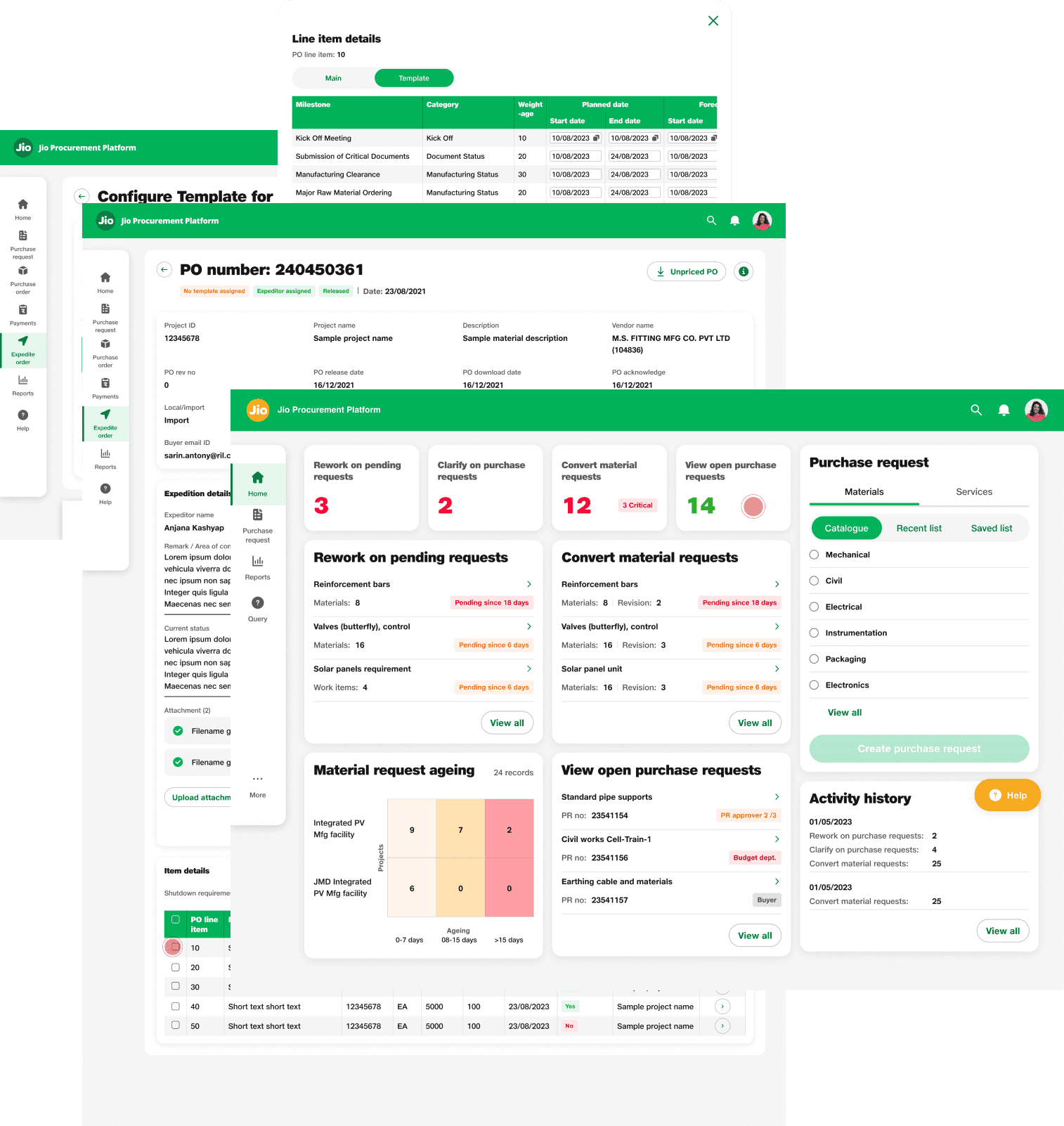
Dashboard Analytics: Data visualisation and summary modules surfacing procurement health, pending approvals, and asset utilisation across departments.
PR to PO: The end-to-end journey of a purchase request from creation by an L3 or L4 employee through all approval stages, with a feedback and escalation system built in.
Bank Guarantee: User flows for initiating and managing Bank Guaranteed Purchase Orders, balancing legal accuracy with operational speed.
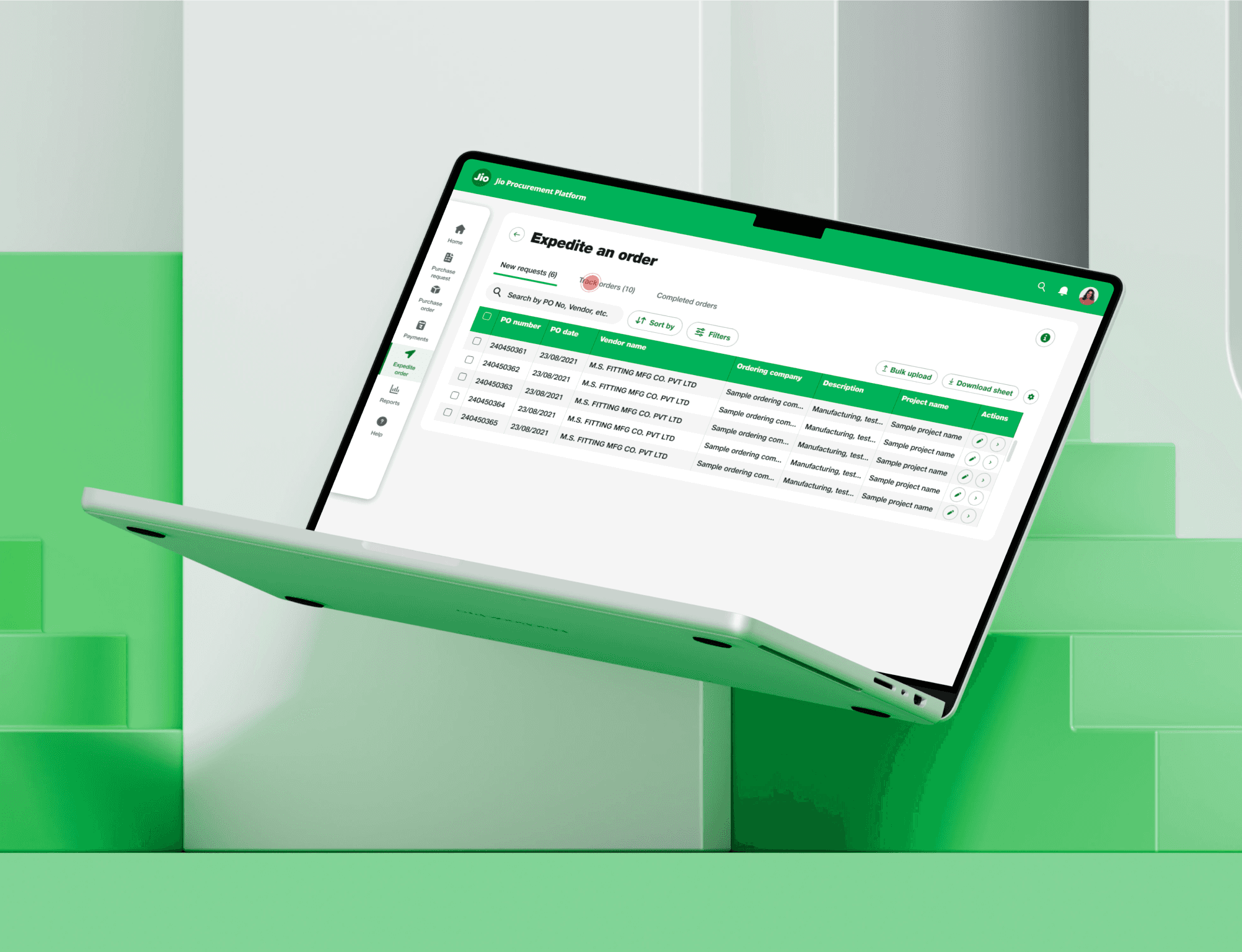
Order Expedition: All flows for expediting an existing order within the system, designed for time-sensitive procurement scenarios without bypassing compliance steps.
Miscellaneous: Collaborated with other designers across smaller-to-medium scale journeys within the broader platform ecosystem.
OUTCOME
The component library built during this engagement was adopted as the JPP platform standard, used to onboard subsequent designers and developers to the system. Five core journeys shipped end-to-end: Dashboard Analytics, PR to PO, Bank Guarantee, Order Expedition, and supporting flows across the broader procurement ecosystem.
The defining challenge of this project was translating SAP-class ERP logic into interfaces that four distinct user roles could navigate without specialist training. That constraint, designing for compliance, auditability, and operational scale simultaneously, shaped every architectural and interaction decision made on the platform.